









Data Center
The New Balance of Power, Cooling, and Compute in AI-First Data Centers
Rohan Sheth
January 30, 2026

Artificial intelligence is foundational to enterprise innovation. From large language models and real-time analytics to automation and personalisation, AI workloads are scaling across industries. This growth is not creating pressure on infrastructure – it is accelerating the evolution of energy efficient data centers, designed to support high-performance computing while maintaining operational stability and sustainability.
As AI adoption deepens, data center efficiency is emerging as a strategic enabler of long-term scalability and business value.
AI workloads consume significantly more power because they rely on densely packed GPUs operating continuously at high utilisation, unlike traditional enterprise applications that run intermittently. Unlike traditional enterprise applications with predictable and intermittent demand, AI training and inference require high-throughput storage, low-latency interconnects, and sustained GPU utilisation. This results in significantly higher AI power consumption, making power management a core design consideration rather than an operational constraint.
To address this, modern data centers are built with power-aware infrastructure that aligns energy delivery directly with workload behaviour. Intelligent power distribution systems monitor IT load in real time, ensuring power is delivered precisely where and when it is required. This load-aware approach supports high-density racks while minimising energy waste, allowing compute capacity to scale without inefficiencies.
Rather than focusing solely on adding electrical capacity, AI-ready facilities prioritise how efficiently power is converted into usable compute. By optimising power paths, reducing losses, and aligning delivery with application demand, data centers gain tighter control over data center energy usage. For enterprises, this translates into predictable operating costs, consistent performance, and fewer infrastructure bottlenecks as AI workloads scale.
AI-ready infrastructure must scale without friction. Energy efficient data centers are engineered to support this by balancing performance, reliability, and sustainability. Efficiency-focused design enables higher rack densities, consistent uptime, and optimised operating costs – key requirements for AI production environments.
Common characteristics of efficient AI-ready facilities include:
1. Power delivery aligned closely to IT load
2. Support for high-density racks without thermal compromise
3. Advanced cooling architectures designed for continuous operation
4. Modular infrastructure that scales incrementally
These capabilities allow organisations to transition from AI experimentation to enterprise-wide deployment smoothly.
The global AI surge has reinforced the importance of the hyperscale data center, where efficiency is achieved through scale, automation, and purpose-built design. At the same time, many enterprises are choosing the colocation data center model to access similar levels of efficiency without owning and operating large facilities.
Colocation environments provide shared access to optimised power, cooling, and physical infrastructure, enabling enterprises to deploy AI workloads faster while retaining operational control. This model also supports geographic flexibility, helping organisations position AI infrastructure closer to users and data sources.
In AI-intensive environments, sustainability is emerging as an outcome of good systems engineering rather than a separate objective. As compute density increases, inefficiencies in power conversion, thermal management, or workload placement compound rapidly, affecting not only energy consumption but also performance stability and infrastructure lifespan. Addressing these inefficiencies improves system behaviour under sustained AI load.
Advanced data centers increasingly optimise for effective compute per unit of energy rather than absolute power availability. This shifts design priorities toward tighter coupling between power delivery, cooling response, and workload orchestration. Closed-loop cooling architectures, higher operating temperatures where appropriate, and renewable-backed power procurement all contribute to smoother performance curves under variable AI demand.
From an enterprise perspective, data center efficiency becomes a mechanism for risk management. Predictable thermal and power behaviour supports higher utilisation without increasing failure rates, while transparent energy metrics simplify compliance and reporting. In this context, sustainability does not slow AI adoption – it enables controlled, repeatable scaling of AI workloads over time.
Yotta builds and operates India’s largest data center parks across strategic locations, purpose-built to support high-performance and AI-driven workloads. Yotta’s multi-tenant colocation data center facilities offer scalable, secure environments with a strong focus on data center efficiency.
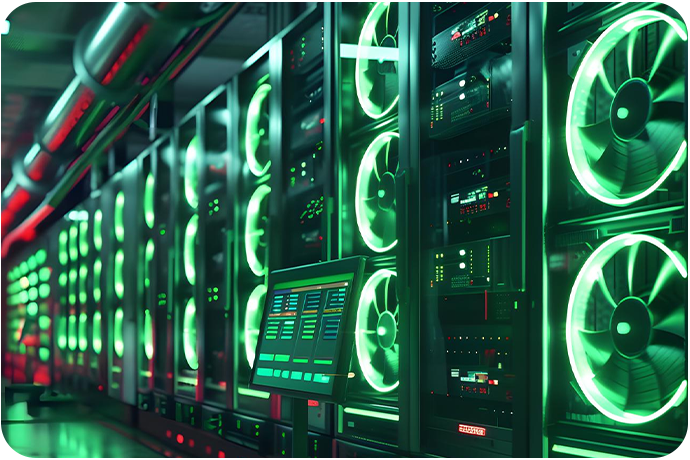
Yotta’s cooling systems are designed for long-term efficiency, not corrective retrofits. Closed-loop, air-cooled architectures using adiabatic and free-cooling significantly reduce water usage by minimising reliance on evaporative cooling for most of the year. For high-density AI racks, Yotta is rolling out direct-to-chip and immersion liquid cooling, both operating in sealed, closed-loop systems with near-zero water loss.
Efficiency is reflected in Yotta’s facility design metrics. Yotta NM1 is designed for a PUE of 1.5, while Yotta D1 operates at a PUE of 1.4, enabling optimised data center energy usage without compromising performance or resilience. Combined with high-efficiency power delivery, redundant AC/DC supply modes, on-demand scalability, and 48-hour full-load backup, Yotta provides a stable foundation for AI growth. Hosting Shakti Cloud within its facilities, Yotta enables organisations to build and deploy advanced AI models on Indian soil, backed by energy-efficient, future-ready data center infrastructure. Visit https://colocation.yotta.com/