











Data Center
The New Balance of Power, Cooling, and Compute in AI-First Data Centers
Rohan Sheth

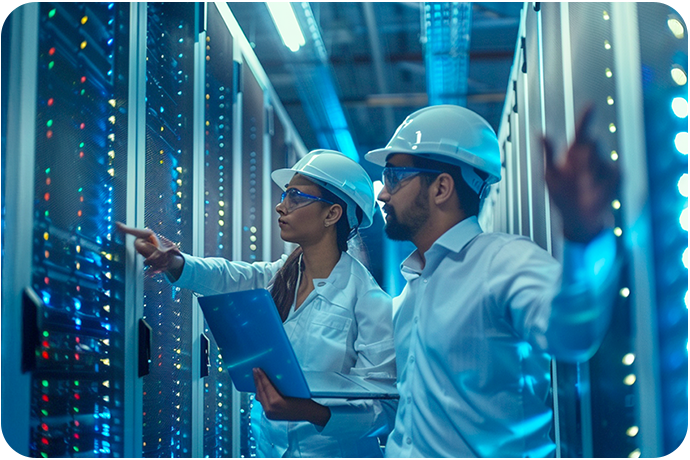
Artificial intelligence is transforming not only applications but the very infrastructure that powers them. The rise of AI workloads – ranging from large language model (LLM) training to real-time inference – has created new demands for AI-ready data centers that can support unprecedented levels of compute, storage, and networking performance. Unlike traditional IT workloads, AI requires tightly coupled GPU clusters, ultra-fast storage, and deterministic low-latency networks.
According to Fortune Business Insights, the global AI data center market was valued at $17.73 billion in 2025 and is expected to expand from $21.27 billion in 2026 to $133.51 billion by 2034. This shift has turned data center construction from a purely operational exercise into a strategic initiative, directly impacting business competitiveness in an AI-driven world.
Colocation data centers have long been valued for providing secure space, power, and connectivity. Today, they must go further. Modern colocation environments are expected to host AI-optimized racks, support high-density GPU clusters, and offer direct access to cloud and network ecosystems. Enterprises increasingly view colocation as an extension of their core infrastructure a place where critical AI workloads can run efficiently without the overhead of managing a private data center. The ability to scale compute capacity on demand, coupled with secure, high-speed interconnects, is now a defining feature of colocation facilities in the AI era.
The concept of the hyperscale data center has evolved from a mere physical scale to a philosophy of modularity, efficiency, and agility. Hyperscale facilities are engineered to handle tens of thousands of servers, thousands of GPUs, and petabytes of storage, all while maintaining predictable performance. For AI workloads, hyperscale architecture provides the flexibility to deploy GPU-powered superclusters, manage distributed training efficiently, and scale compute density rapidly. Standardized designs enable operators to expand capacity without extensive redesigns, ensuring that infrastructure keeps pace with rapidly evolving AI demands.
High-performance AI workloads have made data center power and cooling solutions critical to operational success. Traditional air-cooled designs often fail to meet the heat density of modern GPU clusters, necessitating innovations such as immersion cooling, liquid-cooled racks, and chilled-water systems. On the power side, dual-feed utility inputs, Tier III/IV redundancy, and integrated UPS + generator systems ensure continuous operation for mission-critical AI training and inference. Energy-efficient designs, including free-air cooling and intelligent PUE optimization, allow data centers to maintain performance without compromising sustainability an increasingly important consideration in hyperscale infrastructure.
Data center design for AI workloads requires foresight across multiple dimensions. Floor space must accommodate high-density racks with heavy load capacities. Network fabrics, including high-bandwidth NVLink and InfiniBand, must support massive parallel data flows. Storage systems need high IOPS and low-latency access to feed AI pipelines continuously. Finally, scalability must be embedded from day one, allowing AI clusters to grow from hundreds to thousands of GPUs seamlessly. This holistic approach ensures that the data center is not only AI-ready at launch but capable of adapting to next-generation AI architectures.
In India, Yotta Data Centers exemplify the future of AI-ready and hyperscale infrastructure. With a portfolio spanning operational and upcoming facilities across the country, Yotta combines flexibility, security, and scalability to meet the nation’s growing digital demands. Its flagship NM1 facility in Navi Mumbai, Asia’s largest Tier IV data center, spans 820,000 sq. ft. with 7,000+ racks and a 52 MW IT load, designed for hyperscale growth to 1 GW. IGBC Platinum-rated and built with energy-efficient systems (PUE < 1.5), it provides high-density compute capacity, low-latency network access, and carrier-neutral connectivity for seamless AI operations. Yotta’s data center hosts thousands of NVIDIA H100 GPUs, with upcoming B200 GPUs ensuring readiness for next-generation model training and inference. High-speed NVMe storage, ultra-low latency networking, and high-density rack designs allow enterprises to scale AI clusters without disruption.
Other Yotta facilities, including D1 in Greater Noida and G1 in GIFT City, extend the company’s footprint with Tier III+ and specialized hyperscale infrastructure, featuring advanced cooling systems, scalable power architecture, and district cooling integration.
Yotta’s approach goes beyond hardware. Its AI data center infrastructure is sovereign by design, ensuring all workloads remain within India’s borders to meet compliance, data residency, and governance requirements. Advanced security layers—from biometric access to 24×7 SOC/NOC monitoring—protect sensitive AI workloads. With integration into the Yntraa Cloud platform, Yotta supports private, public, hybrid, and government cloud deployments, enabling mission-critical AI applications to run continuously with 99.999% uptime. By combining hyperscale power, advanced cooling, high-speed storage, and ultra-low latency fabrics, Yotta is not just building data centers—it is powering India’s AI ambitions city by city.