











Data Center
The New Balance of Power, Cooling, and Compute in AI-First Data Centers
Rohan Sheth
January 30, 2026

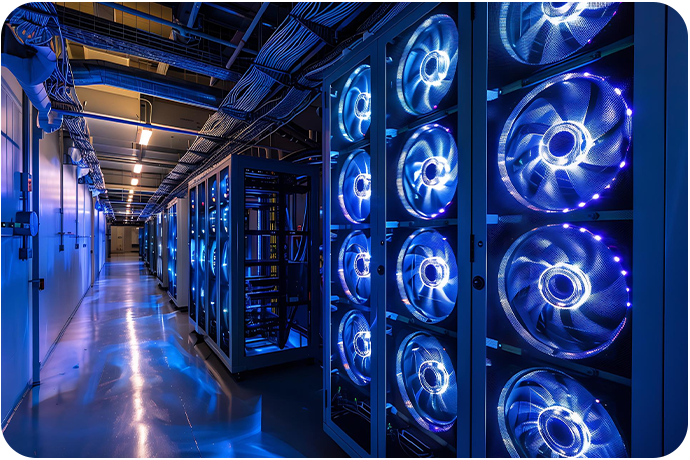
As artificial intelligence (AI), machine learning (ML), and high-performance computing (HPC) workloads intensify, traditional air-cooling systems in data centers are approaching their thermal and energy limits. The exponential increase in power density – especially with racks exceeding 30–50 kW – demands a new approach to heat management. Liquid cooling has emerged as the most efficient and sustainable solution for managing these high thermal loads. Yet, for many operators, building new liquid-cooled facilities from the ground up may not be practical. The real opportunity lies in leveraging existing air-cooling infrastructure to enable liquid cooling, creating a flexible, scalable, and cost-effective hybrid cooling strategy.
Hybrid Cooling Solutions for Data Centers
Hybrid cooling solutions for data centers combine the best of both worlds – air and liquid cooling – allowing operators to gradually transition without disrupting operations. In this model, conventional Computer Room Air Conditioning (CRAC) or Air Handling Units (AHUs) continue to manage low-to-medium density racks, while high-density zones are retrofitted with liquid cooling systems such as direct-to-chip or rear-door heat exchangers.
This approach enables operators to optimsze cooling performance based on rack density, energy use, and workload type. For example, workloads like web hosting or storage can continue using air cooling, while AI training or GPU clusters benefit from the precision of liquid cooling. The result is a dynamic cooling ecosystem that maximises thermal efficiency while minimising infrastructure overhaul.
Making the Transition from Air to Liquid Cooling
The transition from air to liquid cooling is not as disruptive as it might seem. Many data centers already have advanced air-cooling systems – chilled water loops, raised floors, and hot-aisle containment – that can be extended to support liquid cooling. By reusing existing mechanical and electrical systems, operators can significantly reduce capital expenditure and implementation time.
Retrofit options such as direct-to-chip liquid cooling systems, which use a sealed liquid circuit to absorb heat directly from processors, can be integrated without replacing entire cooling networks. Similarly, immersion cooling setups where servers are submerged in dielectric fluid can be deployed in isolated sections to handle extreme workloads. These hybrid deployments pave the way for a more energy-efficient data center cooling environment without necessitating full infrastructure replacement.
Moreover, using existing air-cooling infrastructure as a foundation accelerates the sustainability journey. Rather than demolishing and rebuilding, facilities can evolve toward greener technologies in an incremental, resource-conscious manner. This adaptive path is critical as the industry targets net-zero operations and improved Power Usage Effectiveness (PUE).
The Efficiency and Sustainability Payoff
Liquid cooling is inherently more thermally efficient than air cooling, as liquids can carry heat 1,000 times more effectively than air. When integrated smartly into legacy systems, the combination enhances overall operational efficiency and reduces energy consumption. This contributes directly to energy-efficient data center cooling, which is becoming a top priority for operators worldwide.
In fact, liquid-assisted air-cooling configurations can reduce cooling energy use by up to 30–40%. They also allow for higher rack densities within the same footprint, leading to better space utilization and reduced overhead. In a time when electricity costs and environmental regulations are tightening, such hybrid models are key to achieving data center sustainability goals.
The Role of Colocation Data Centers in the Cooling Evolution
For enterprises hosting workloads in a colocation data center, the shift to hybrid cooling offers distinct advantages. Unlike single-tenant facilities, colocation environments support diverse client needs from low-density racks to AI clusters requiring liquid cooling. By adopting hybrid cooling architectures, colocation providers can deliver flexibility, higher efficiency, and greater reliability for a wider range of customer workloads.
Modern colocation providers are actively investing in retrofit-ready infrastructure to accommodate both traditional and next-generation cooling systems. This adaptability ensures that clients can future-proof their deployments without costly migrations. As businesses move toward hybrid IT environments, a colocation data center offering flexible cooling options becomes a strategic enabler of digital transformation and long-term sustainability.
Overcoming Integration Challenges
While the advantages are clear, integrating liquid cooling into an air-cooled environment requires careful planning. Factors such as facility layout, load distribution, and coolant management must be considered. Operators must also ensure that the cooling retrofits do not interfere with existing airflow dynamics.
Moreover, effective monitoring and maintenance systems are crucial. Hybrid environments demand advanced control platforms capable of real-time temperature tracking, predictive maintenance, and automated response systems to maintain optimal performance. Fortunately, modern Data Center Infrastructure Management (DCIM) tools can seamlessly handle such complexity.
Smarter Path to Data Center Cooling wit Yotta
Yotta’s data centers are engineered to meet the rising cooling and performance demands of next-generation workloads. Combining air-cooled chillers with adiabatic and free-cooling systems, Yotta minimises water use while maintaining exceptional energy efficiency. To support high-density AI and GPU workloads, the company operates direct-to-chip and immersion liquid cooling within its facilities. With resilient infrastructure, multi-layer security, and redundant connectivity, Yotta’s colocation data center ecosystem offers enterprises a dependable foundation for hybrid IT growth and long-term sustainability.
Conclusion
As the global data landscape continues to expand, the ability to modernise cooling without rebuilding from scratch will be critical. Leveraging existing air-cooling infrastructure to integrate liquid systems enables a smoother, more sustainable transition that balances performance, cost, and environmental impact. By embracing hybrid cooling and efficiency-focused innovation, operators can future-proof their facilities and reduce their carbon footprint – a crucial step toward achieving data center sustainability in the era of AI and high-density computing.