











Data Center
DPDP and Data Center Compliance in India: A 2026 Checklist for CIOs
Jyoti Malde
August 13, 2026

The exponential growth of artificial intelligence is redefining the very foundations of digital infrastructure. Traditional data centers, long optimized for general-purpose computing, can no longer meet the scale and intensity of AI workloads. In India, the next wave of AI-ready data centers is being purpose-designed to manage enormous computational throughput, high-density GPU clusters, and ultra-fast, low-latency storage, while simultaneously prioritizing energy efficiency and operational resilience. These facilities are no longer just about space and power – they are complex ecosystems where power distribution, advanced cooling architectures, and scalable compute capacity must converge seamlessly. This infrastructure can meet the intense demands of AI training and inference, supporting faster and more efficient deployment of artificial intelligence.
AI workloads are energy-intensive. Training large models, running inference on massive datasets, and enabling real-time analytics require sustained high-power draw at scale. Data center power consumption has become one of the primary constraints in AI infrastructure planning. Modern AI-first data centers are engineered to handle dense GPU racks while providing robust redundancy through dual utility feeds, backup generators, and uninterrupted power supply (UPS) systems. Careful planning of electrical architecture ensures that peak computational demand does not compromise uptime, enabling enterprises to run AI workloads reliably while optimizing operational costs.
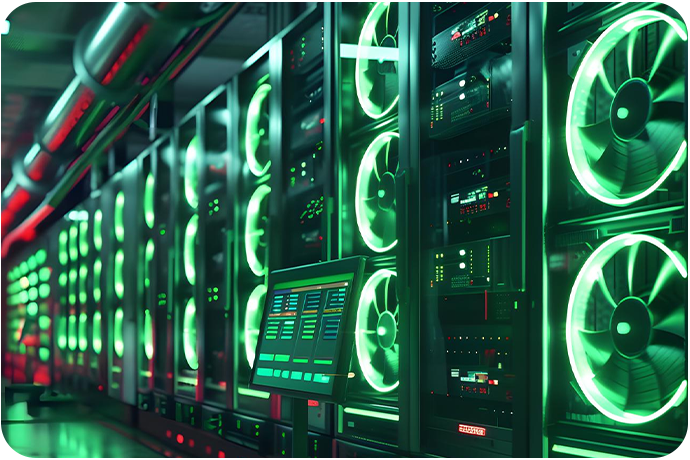
One of the most significant innovations in AI infrastructure is the adoption of liquid cooling for data centers. Traditional air-based cooling systems often struggle to dissipate the heat generated by dense GPU clusters, leading to thermal hotspots and reduced equipment lifespan. Liquid cooling – whether direct-to-chip immersion, rear-door heat exchangers, or chilled-water systems – provides superior heat transfer, allowing high-density racks to operate efficiently. This technology not only improves performance for AI workloads but also reduces the overall energy footprint, helping operators achieve better PUE metrics.
The challenge of AI-first data centers lies in harmonizing compute density, cooling efficiency, and power availability. AI data center infrastructure must support ultra-high-bandwidth networking, low-latency storage, and large-scale GPU clusters without compromising environmental performance. Energy-efficient data centers integrate smart cooling strategies, workload-aware power management, and advanced monitoring to optimize resource usage dynamically. Techniques such as cold aisle containment, variable-speed pumps, and adiabatic cooling allow operators to maintain consistent performance while minimizing energy and water consumption, making sustainability an integral part of AI infrastructure design.
Modern AI workloads evolve rapidly, and data center architecture must keep pace. Modular design principles – enabling scalable racks, flexible power distribution, and adaptable cooling systems -allow data centers to expand incrementally as compute demand grows. By adopting a “compute-first” approach that considers power and cooling as inseparable design parameters, operators can maximize operational efficiency while ensuring that future AI applications can be deployed without costly retrofits or downtime.
India’s AI ecosystem is rapidly expanding, and the demand for purpose-built AI infrastructure is growing in parallel. AI data centers in India are not just supporting enterprise AI; they are enabling national initiatives in healthcare, finance, and government technology. As the country pursues leadership in AI-driven innovation, energy-efficient, resilient, and high-performance facilities are critical to sustaining growth. Operators must consider not only compute density but also the environmental and regulatory implications of high energy consumption, making sustainable cooling and power management a strategic priority.
Among India’s AI data center leaders, Yotta Data Centers exemplify the balance of power, cooling, and compute required for AI-first operations. Yotta’s facilities integrate advanced AI data center infrastructure, including high-density GPU clusters, ultra-fast NVMe storage, and low-latency networking, enabling enterprise-scale AI workloads with unmatched reliability. To address the challenge of energy and thermal management, Yotta deploys cooling innovations such as adiabatic chillers, rear-door cooling, direct-to-chip liquid cooling, and cold aisle containment. These technologies reduce both energy and water usage while ensuring optimal operating temperatures for dense AI clusters. By combining robust power systems, modular compute architecture, and sustainable cooling solutions, Yotta delivers energy-efficient data centers that are purpose-built for India’s AI ambitions, supporting everything from hyperscale cloud deployments to sovereign data initiatives.
As AI continues to reshape industries and drive innovation, the role of purpose-built, energy-efficient data centers will only grow more critical. Success in this era requires facilities that seamlessly integrate power, cooling, and compute, while remaining adaptable to evolving workloads.
In India, operators who prioritize resilient, sustainable, and high-performance AI infrastructure will not only meet the demands of today’s enterprises but also lay the foundation for the next generation of technological breakthroughs. By aligning design, operations, and environmental responsibility, AI-first data centers are poised to become the backbone of India’s digital future.